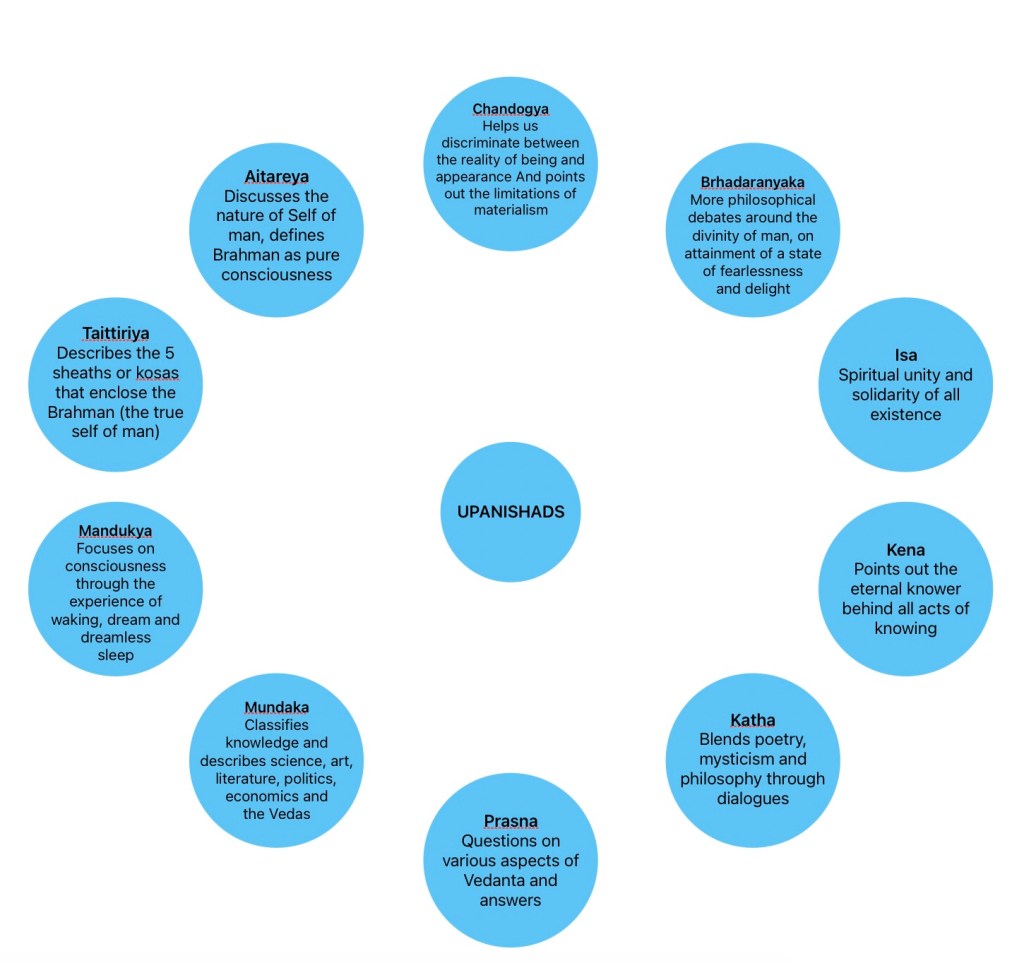
The principal Upanisads are accepted to be the ten which Sankaracharya (A.D. 788-820) chose to comment upon:
Isa, Kena, Katha, Prasna, Mundaka, Mandukya, Taittiriya, Aitareya, Chandogya and Brhadaranyaka
What are the 4 Mahavakyas and their meaning?
- Tat Tvam Asi (तत् त्वम् असि) – traditionally interpreted as “That Thou Art” (that you are), (Chandogya Upanishad 6.8.7 of the Sama Veda)
- Ahaṁ Brahmāsmi (अहं ब्रह्मास्मि) – “I am Brahman”, or “I am Divine”(Brihadaranyaka Upanishad 1.4.10 of the Yajur Veda)
- Prajñānaṁ Brahma (प्रज्ञानं ब्रह्म) – Brahman is pure consciousness (Aitareya Upanishad 3.3 of the Rig Veda)
- Ayam Ātmā Brahma (अयम् आत्मा ब्रह्म) – “This Atman (Self of man) is Brahman” (Mandukya Upanishad 1.2 of the Atharva Veda)
Upanishads are the basis for all Hindu (and Buddhist) thinking. The Upanishads do not see the Atman or Brahman as an illusion (Maya). Maya is a statement of fact – what we are an what we see around us. It refers to the inner contradictions in our experiences of the world and the knowledge of it. The contradictions remain at our sensory level. We have to move from this lower truth to a higher truth, taking into account the Atman – the ultimate truth.
The theme of the Upanisads is freedom of the human spirit and their message is fearlessness and love and service. The goal being to help each man or woman realise his or her essential spiritual nature without being bound by any limits.
The Upanisads focus on spiritual truths and classified as “sruti“. Religious literature, also known as “smriti‘ combine spiritual material along with myths, legends and cosmological theories (The Gita, The Mahabharata, The Ramayana and the Puranas). The smriti is always subordinate to the sruti in spiritual matters. Smriti must evolve and allow for change over time as the socio-economic conditions change. Just as science advances with new knowledge, so must the smritis. However, smritis though not that authoritative, may be binding under particular circumstances, times and places. Srutis or the Vedas embody the relationship between souls and Gods. The Smritis are embodied in the words of Manu, Yajnavalkya and in the Puranas.
Religions have two components – essential truths and non-essential practices and propositions. Sanatana dharma or “Eternal religion” derives its authority from its truth-character and not from any person. Its truth-character demands that it be verifiable by all, irrespective of dogma, creed and race, and at all times. It is based on principles rather than personalities.
How does one determine validity of a scriptural statement? It must have the capacity to generate certain and fruitful knowledge. The true Vedantic spirit does not start with preconceived ideas. Never having been hampered by priestly order, each man is free to search wherever he pleases for the spiritual explanation of the spectacle of the universe.
An understanding of our soul cannot come from the use of our senses – it comes from introspection. To understand sciences, we need to read books on sciences and conduct experiments in the physical world. To learn about religion, we have to work with our mind and our heart. A prayer that reflects this desire to seek the truth can found in Brhadãranyaka Upanisad, I. 3. 28:
Asato mã sadgamaya; Tamaso mã jyotirgamaya; Mrtyor mã amrtam gamaya—
From the unreal lead me to the Real;
From darkness lead me to Light;
From death lead me to Immortality.’
“The human mind has lost its bearings in the delusion of wealth and power’, pramadyantam vittamohena mudham (Katha Upanisad, II. 6)
This is the challenge facing human knowledge and wisdom. So what should Man do? He must transcend the limitations of his senses, to realise his immortal, divine nature and strive for perfection, for the highest level of human existence.
Upanisads are not “old” texts. They have a modern outlook and do not impose anything, they enable Man to ask questions and seek answers.
For a long period of time, the Upanisads were kept secret from the masses. It was the great philosopher Sankaracharya in the eighth century A.D. who made it accessible to the general public. Subsequently, it was Swami Vivekananda who promoted the Upanisads further, in simple language, not just to Indians but to people in other countries across the world.
Chapters 2,3
Isa Upanishad_1,2
Understanding the world that we are a part of:
Purnamadah purnamidam
purnat purnamudacuate;
Purnasya purnamadaya
purnamevavasisyate.
Om santih, santih, santih—
The visible world has come about from a world that is invisible (Brahman). The world that is invisible (Brahman) remains the same, even after the visible universe has come out of the Full (Brahman). This chant is an invocation for peace.
Another way of defining “Brahman” is as in Taittiriya Upanisad, III. 1:
‘That from which all these entities and beings are born,
That in which, being born, they live,
That unto which, in the end, they enter;
know That; That is Brahman
While physical sciences can explain the world from outside, we need philosophy (as in Upanishads) or religion, to understand the world from inside. Having both these perspectives is true knowledge. The truth has to be churned out by enquiry and meditation. At this stage, there is no “outside” or “inside” – its total reality.
The goal of our lives is fulfilment (purnata) and this comes from renunciation of things that are not ours and things that are not real. Focus on things that you truly possess and enjoy life with zest. What are the constituents of “Happiness”?
- Wealth
- Youth
- Goodness
- Education, Creative intelligence
- Hope & aspiration
- Firmness of mind and purpose
- Health
According to the vedas, the human life span is a one hundred years, provided an individual lived his life healthily, physically and mentally. Poor diet and lack of sanitation reduce our life span. In India, this had dropped to as low as 29 years at the beginning of the 19th century. We need to overcome laziness and indifference and fill our lives with useful actions, dedicating them to God.
The purpose of religion is to develop a positive attitude. True religion suffers when it falls into the hands of weak people. We need to develop strength of will and character through the service of man, even before we try to understand the Upanisads.
Man must use his body, as an instrument, to work and, through work, to create beauty, wealth, and welfare outside, and moral and spiritual development within. An essential teaching of the Upanisads is:
” To make others happy is my happiness, to serve others and help them achieve their life’s fulfilment, is my fulfilment”. However, merely doing good for the ego or to compensate for the emptiness you feel in your heart will not go very far because when confronted by challenges in our lives, doing good becomes secondary.
Both, “Materialism” and Vedanta seek to get most of out of life but the biggest difference is in what is gained.
Chapter 4
Isa Upanishad_3
Man and nature is one and all individuals are a part of the Ātman. The Atman is infinite and immortal. The question then is, how to experience the infinite. By attempting to define it, we limit it. In Vedanta, the space or akasa as the nearest symbol of the Infinite.
Atman travels faster than the light, faster than our senses and faster than the mind. Yet, it is motionless. It is pure being and pure awareness.
 the-flying-yogi.com